
The 2026 Toyota Camry is a midsize sedan that now comes exclusively as a hybrid, dropping the traditional gas-only engine option that buyers have relied on for decades. This model year carries over the striking ninth-generation redesign that Toyota introduced for 2025, so it’s better described as a continuation of that new look rather than a fresh start. Toyota now treats hybrid powertrains as the default across its high-volume models, and the Camry stands as the clearest example of that shift. For a car that has topped America’s midsize sedan sales charts for years, this is one of the biggest changes to its formula in a long time.
What Powers the 2026 Camry
Every 2026 Camry, regardless of trim, uses the same core hybrid hardware, which means shoppers no longer have to weigh fuel economy against features when choosing a version. The lineup runs on Toyota’s fifth-generation hybrid system, pairing the 2.5-liter four-cylinder engine with electric motors and delivering 163 lb-ft of torque, with front-wheel-drive models producing 225 horsepower. Buyers who want extra traction can step up to all-wheel drive, and that choice comes with a small power bump. AWD-equipped Camrys add a dedicated rear electric motor, pushing total output to 232 net-combined horsepower.
Fuel efficiency is where this powertrain really stands out. According to Tustin Toyota, the LE FWD trim earns an EPA-estimated 52 mpg city and 49 mpg highway, working out to 51 mpg combined. That figure puts the Camry near the top of its class, even among other hybrids. AWD models trade a bit of that efficiency for confidence in rain or snow, landing closer to 47 mpg combined according to Toyota Bountiful. The engineering behind this comes down to how Toyota tuned the system’s acceleration feel; the automaker increased power delivery from the lithium-ion battery through the electric motor to smooth out engine revs during hard acceleration, so the Camry doesn’t feel strained even when driven briskly.
Trim Levels and What Each One Offers
Toyota spread the Camry lineup across five trims, giving buyers a way to choose based on style and features rather than powertrain, since every version shares the same hybrid system underneath.
| Trim | What It’s Known For |
|---|---|
| LE | Entry-level trim, best value and starting price |
| SE | Sportier suspension tuning and exterior styling |
| Nightshade Edition | Midnight Black Metallic accents, 19-inch black wheels |
| XLE | Comfort-focused, upgraded touchscreen and gauge cluster |
| XSE | Sport-focused flagship trim with the boldest styling |
The Nightshade Edition is one of the newer additions to the lineup and leans into a blacked-out look, with gloss black badging and unique wheels that separate it visually from the rest of the range. Toyota also added a new Dark Cosmos exterior color option on select grades, giving buyers another way to stand out without moving up to the sportier SE or XSE trims.
Design and Interior Highlights
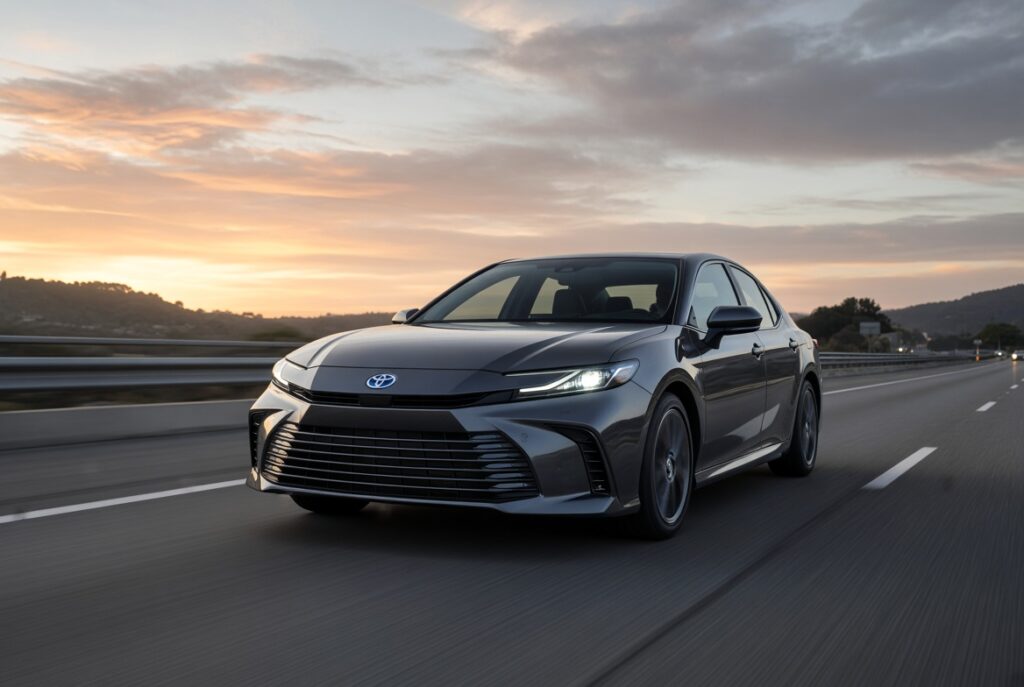
The 2026 Camry keeps the “hammerhead” front-end design that Toyota introduced with the ninth-generation redesign, a styling cue that has become something of a signature across the brand’s newer models. LED headlights and daytime running lights come standard on every grade, and the overall silhouette leans lower and sleeker than the outgoing generation, with a ground clearance of 5.4 inches that favors handling and aerodynamics over rugged capability.
Inside, technology has moved up a notch across the board. Every Camry includes wireless Apple CarPlay, wireless Android Auto, a Qi wireless charging pad, five USB ports, and Toyota Safety Sense 3.0 as standard equipment. Step up to the XLE or XSE trims and the cabin gains a 12.3-inch touchscreen paired with a 12.3-inch digital gauge cluster, replacing the smaller displays found on lower trims. SofTex, Toyota’s synthetic leather upholstery, comes standard on the SE and Nightshade Edition and weighs about half as much as genuine leather while resisting stains and spills better, needing little more than soap and water to clean.
Comfort options continue to expand further up the lineup. A power tilt/slide moonroof is available on the LE, SE, and Nightshade trims, while the XLE and XSE offer a panoramic glass roof with a power sunshade. Cabin space is also generous for the segment; front-seat passengers get 38.3 inches of headroom without a moonroof, and the car measures 193.5 inches long and 72.4 inches wide, putting it firmly in the traditional midsize sedan footprint.
Safety and Reliability
Toyota Safety Sense 3.0 comes standard across the entire lineup, bundling features like pre-collision detection, lane-departure alerts, and adaptive cruise control into every trim rather than reserving them for pricier versions. That standard safety suite has paid off in testing. The 2026 Toyota Camry Hybrid earned a 5-Star Safety Rating from the National Highway Traffic Safety Administration. Combined with Toyota’s long-standing reputation for dependability, that rating gives the Camry a strong case for families cross-shopping midsize sedans against compact SUVs.
Pricing
The 2026 Camry remains competitively priced for a nameplate that has shifted entirely to hybrid power. The LE trim starts at roughly $29,000, which keeps it within reach of shoppers who might otherwise consider a gas-only competitor. Moving up through SE, Nightshade, XLE, and finally XSE increases the price alongside the added styling and technology, but the hybrid powertrain and fuel economy stay consistent no matter which trim buyers choose.
Frequently Asked Questions
Is the 2026 Toyota Camry only available as a hybrid?
Yes. Every 2026 Camry comes standard with Toyota’s fifth-generation hybrid system, and there is no gas-only engine option anywhere in the lineup.
How much does the 2026 Toyota Camry cost?
Pricing starts at approximately $29,000 for the base LE trim, with the price increasing through SE, Nightshade Edition, XLE, and XSE trims as more features and styling are added.
What is the fuel economy of the 2026 Camry?
The front-wheel-drive LE trim earns an EPA-estimated 51 mpg combined, while all-wheel-drive models land closer to 47 mpg combined due to the added weight and mechanical drag of the rear electric motor.
Is the 2026 Camry a new redesign or a carryover model?
it’s a carryover. The 2026 model keeps the ninth-generation redesign that Toyota launched for the 2025 model year, with the main news being the completed shift to a hybrid-only lineup.
Do you need to plug in the 2026 Camry?
No. The Camry Hybrid charges its battery automatically through regenerative braking and the gasoline engine, so it’s fueled at the pump just like a conventional car, with no charging cord or plug required.