
BMW has completed a $1.7 billion expansion of its South Carolina manufacturing operations, adding new capacity specifically aimed at electric vehicle production as the automaker works to grow its EV lineup in the United States. The investment covers an expansion of the existing Plant Spartanburg facility along with construction of an entirely new plant, Plant Woodruff, marking one of the largest single manufacturing commitments BMW has made in North America.
Inside BMW’s $1.7 Billion Investment
Plant Spartanburg has long been BMW’s largest manufacturing site anywhere in the world, and this expansion cements its role even further. The completed investment supports production of BMW’s fifth-generation X5 lineup, with the new SUV now rolling off the line at the newly expanded facility. Alongside the Spartanburg expansion, BMW also built Plant Woodruff, a new facility constructed specifically to support the automaker’s growing EV production needs.
Together, the two facilities give BMW significantly more manufacturing capacity in the U.S. at a moment when automakers across the industry are trying to figure out how quickly to scale up electric vehicle output. BMW’s approach leans toward measured, steady investment rather than a rapid all-in shift, spreading its bets across both electrified and combustion-powered models built on the same expanded footprint.
Why Automakers Are Investing in U.S. Plants Right Now
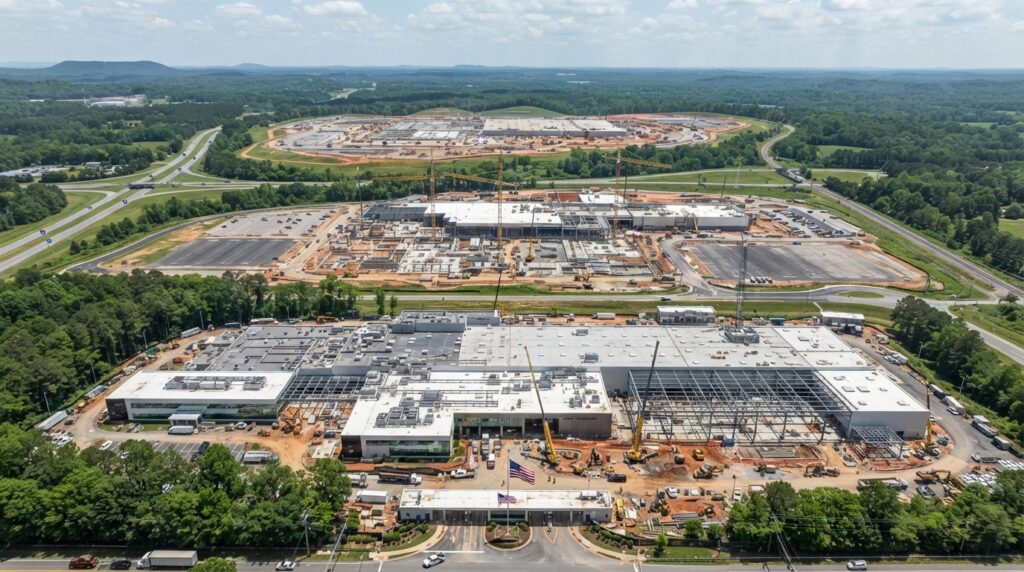
BMW isn’t alone in pouring money into American manufacturing this year. Several other major automakers have announced significant plant investments in 2026, each with a slightly different strategy behind it.
- Stellantis committed $13 billion to scale its U.S. operations, including plans to reopen the Belvidere Assembly Plant in Illinois, which had been closed since 2023. That plant is set to restart in 2027 to build the Jeep Cherokee and Jeep Compass, creating an estimated 3,300 jobs in the region. Stellantis is targeting a 50 percent increase in yearly vehicle production as part of the broader push.
- Rivian amended its federal construction loan for a planned Georgia plant, reducing its total borrowing by $2 billion while actually expanding the first phase of the factory. The changes allow that first phase to reach an annual capacity of 300,000 vehicles, a 50 percent increase over the automaker’s prior plans.
- Kia is investing $649 million in a Mexico plant to produce its EV3 electric SUV starting in 2026, a project expected to create roughly 2,000 jobs and expand local EV charging infrastructure.
- Stellantis in Mexico is separately expanding two additional plants, with its Toluca facility set to begin assembling both a Cherokee hybrid and the Recon EV.
Taken together, these investments suggest automakers are still committed to expanding EV production capacity, even as actual EV sales growth has been uneven and harder to predict than many companies expected a few years ago.
A More Cautious, Flexible Approach to EV Manufacturing
Not every automaker is charging ahead with pure EV plants the way some announcements from a few years ago suggested they would. Several companies have adjusted their manufacturing strategy to hedge against slower-than-expected EV demand, building flexibility into their plants rather than committing entirely to battery-electric production.
Volkswagen offers a good example of this shift. The automaker’s second-generation Atlas, arriving for the 2027 model year, is taking over as the primary production focus at one of its plants starting in the summer of 2026, with vehicles reaching dealerships that autumn. Volkswagen has acknowledged directly that “the EV market continues to challenge the industry, requiring measured decisions throughout the last few years to navigate this unpredictability.”
Nissan’s experience at its Canton, Mississippi plant shows just how much these strategies can shift. The automaker originally committed $500 million to transform that plant into a North American EV hub. Since then, Nissan formally canceled plans to build fully electric SUVs there and instead redirected the facility toward a V6-powered revival of the Xterra SUV, expected in 2028 with a hybrid option available. That reversal illustrates how quickly EV manufacturing plans can change when demand doesn’t materialize the way a company originally projected.
Plant Investment Strategies Compared
| Automaker | Investment | Focus |
|---|---|---|
| BMW | $1.7 billion | X5 lineup and EV capacity in South Carolina |
| Stellantis (U.S.) | $13 billion | Reopening Belvidere, boosting overall production 50% |
| Rivian | Amended $4.5B loan | Georgia plant, 300,000-vehicle EV capacity |
| Kia | $649 million | EV3 production in Mexico |
| Nissan | $500 million (redirected) | Shifted from EV hub to hybrid Xterra revival |
The spread across this table shows just how differently automakers are approaching the same basic challenge. Some, like BMW and Rivian, are building out dedicated EV capacity with long-term confidence. Others, like Nissan, have pulled back from EV-specific plans in favor of hybrid or combustion options that better match current demand.
What This Means for the EV Market
Plant expansions like BMW’s matter beyond just manufacturing capacity. They signal how confident automakers are in medium-term EV demand, and they often come with ripple effects for suppliers, local job markets, and eventually vehicle pricing and availability. New capacity coming online typically takes a year or more to fully ramp up, so the impact of announcements made in 2026 likely won’t be fully visible to buyers until 2027 or later.
For consumers, more manufacturing capacity generally means better vehicle availability and, over time, more competitive pricing as automakers spread fixed costs across higher production volumes. That said, the uneven demand picture across the industry means not every plant expansion will translate into more EV choices on dealer lots right away. Some of that new capacity, as seen with Volkswagen and Nissan, is being redirected toward hybrid or gas-powered models instead.
Frequently Asked Questions
How much did BMW invest in its South Carolina expansion?BMW completed a $1.7 billion investment covering an expansion of Plant Spartanburg and the construction of a new facility, Plant Woodruff, both supporting EV production.
Which other automakers are expanding U.S. plants in 2026?Stellantis committed $13 billion to U.S. operations, including reopening its Belvidere Assembly Plant, while Rivian amended its federal loan to expand its Georgia plant’s capacity to 300,000 vehicles annually.
Are all these plant expansions focused on electric vehicles?
Not entirely. While BMW, Rivian, and Kia are expanding EV-focused capacity, other automakers like Nissan and Volkswagen have redirected some plant investments toward hybrid or gas-powered models due to uneven EV demand.
When will these new plants start producing vehicles?
Timelines vary by project. BMW’s expansion is already complete and producing vehicles, while Stellantis’s Belvidere plant is set to restart in 2027, and Rivian’s Georgia plant remains under construction.
Will these plant expansions lower EV prices?
Increased manufacturing capacity can help lower costs over time by spreading fixed expenses across more vehicles, but pricing also depends on chip supply, raw material costs, and overall demand, so any price impact will likely take time to show up.