
U.S. new-vehicle sales reached their strongest pace of 2026 in July, with the seasonally adjusted annual rate climbing to roughly 16.7 million units, according to Cox Automotive. That figure marks the fifth consecutive month with a SAAR of at least 16 million vehicles, the longest such streak in more than five years, signaling that buyers who had been sitting on the sidelines earlier in the year are now making their way back into dealerships.
A Slow Start Gives Way to a Stronger Summer
The year didn’t begin this way. The first quarter of 2026 was rough for much of the industry, with a wide range of automakers, including General Motors, Toyota, Ford, Honda, Nissan, Subaru, and BMW, all reporting sales declines compared to the same period in 2025. Much of that weakness reflected an unusually strong March 2025, when buyers rushed to purchase vehicles ahead of anticipated tariffs, making year-over-year comparisons look worse than the underlying trend actually was. Harsh winter weather, high vehicle prices, elevated borrowing costs, and rising gasoline prices added further pressure during those early months.
By spring, the picture started shifting. Cars.com noted that new-vehicle sales figures for early 2026 were declining only slightly, and vehicles were spending noticeably less time sitting on dealer lots, four fewer days on average compared to the prior year. That faster turnover suggested demand was actually healthier than the raw sales numbers implied, since cars were selling more quickly even as fewer of them moved through the system overall.
Momentum Builds Through Midyear
The turnaround became clearer as the year progressed. June 2026 new-vehicle volume landed in the range of 1.35 to 1.4 million units, with the annualized selling pace settling in the mid-16-million range. Forecasts from J.D. Power, GlobalData, and Cox Automotive all pointed to a market performing better than many analysts had expected heading into the summer, even with affordability, interest rates, and elevated household expenses still weighing on buyers.
July pushed that momentum even further. Cox Automotive’s forecast projected a SAAR near 16.7 million for the month, up from June’s 16.5 million pace and representing the strongest sales rate of the year so far. Sales volume was expected to reach around 1.395 million units, a 1.2 percent increase from June, even though volume ran slightly below July 2025’s total. Some estimates were even more optimistic; one industry projection put July sales as high as 1.42 million units with a SAAR approaching 16.9 million.
What’s Driving Buyers Back
A few consistent factors explain why sales have strengthened even as affordability concerns haven’t gone away.
- Pent-up demand. After a slow start to the year, some buyers who delayed purchases in the first quarter appear to be returning to the market as conditions stabilized.
- Record stock market gains. Strong financial markets have historically supported consumer confidence and big-ticket purchases like vehicles, and 2026 has been no exception.
- Hybrid demand. Hybrids have become the clear sweet spot of the market this year. Honda, Hyundai, Kia, and Toyota all demonstrated strong consumer interest in hybrid models through the summer, giving buyers better fuel economy without asking them to adapt to charging infrastructure.
- Rising incentive spending. Automakers have leaned more heavily on incentives to offset high interest rates and affordability challenges, helping close the gap between sticker prices and what buyers are willing to pay.
- Easing loan rates. Slightly more favorable financing conditions have helped some buyers who were previously priced out of the market reconsider a purchase.
Winners and Losers
Not every automaker is benefiting equally from the stronger summer sales pace. Hyundai and Kia have each posted sales increases for three consecutive months and remain on pace for another record year in 2026, building on record U.S. results the two brands posted in 2025. That’s a notable achievement given that the overall U.S. market actually declined slightly during July on a year-over-year basis.
Ford had a tougher month. Ford Motor Company sales fell 10.3 percent in July to 168,920 vehicles, with the Ford brand itself dropping 9.2 percent. Battery-electric vehicles were a particular soft spot across the industry in July; Ford experienced a steep EV sales decline, and Hyundai’s primary EV models were down at least 35 percent compared to July 2025. Some of that comparison reflects timing rather than a pure demand drop, since EV sales had already begun accelerating at this point last year as shoppers rushed to beat the September 2025 expiration of federal EV tax credits.
| Automaker | July 2026 Trend | Context |
|---|---|---|
| Hyundai | Up, third straight monthly gain | On pace for another record year |
| Kia | Up, third straight monthly gain | Following record 2025 results |
| Ford | Down 10.3% | Steep EV decline, F-Series pressure |
| Toyota | Led Q1 2026 sales overall | Still posted a Q1 decline year over year |
What’s Selling Right Now
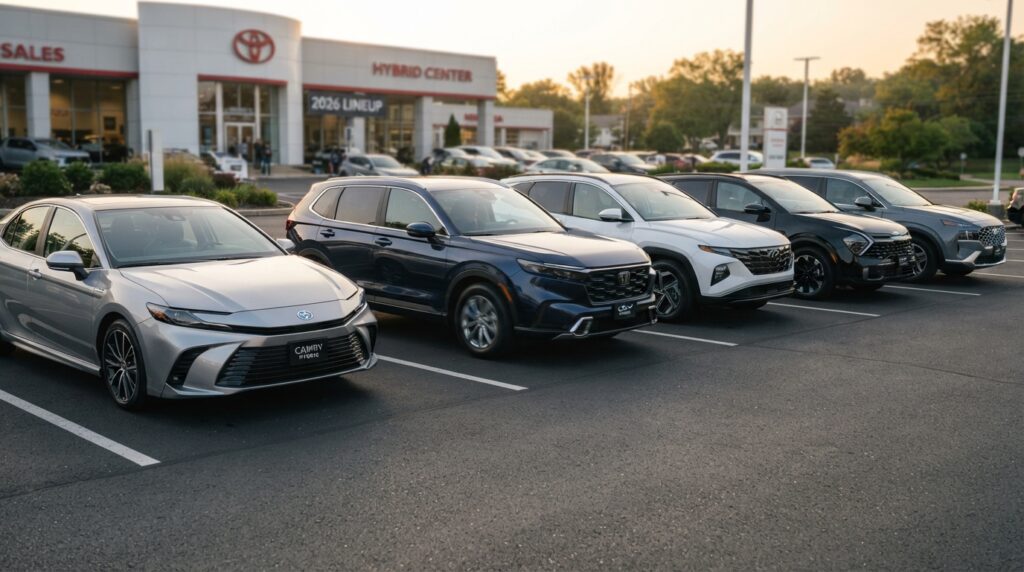
Hybrids and practical crossovers are carrying the market more than pure EVs are right now. The 2026 Toyota Camry has been the best-selling car in America in recent months, with more than 61,000 units sold in a recent 45-day stretch, while the 2026 Honda CR-V holds the title of best-selling SUV with nearly 47,000 units sold over the same window. Trucks and SUVs continue to dominate the top of the sales charts overall, but sedans have started making a modest comeback, helped along by rising gas prices and comparatively affordable starting prices next to larger vehicles.
Why This Matters Going Forward
Analysts see the current sales pace as stable rather than explosive, which may actually be a healthier signal for the industry than a sudden spike. A 16.5 to 16.7 million SAAR is solid by historical standards, even if it isn’t dramatically higher than prior months. Affordability remains the biggest ceiling on the market; there are still plenty of shoppers who would like to buy a new vehicle but can’t comfortably justify today’s transaction prices or monthly payments.
For the rest of 2026, hybrids look positioned to remain the powertrain to beat, giving automakers with strong hybrid lineups a real advantage over brands leaning more heavily on EV growth that hasn’t fully materialized. Dealership profitability has also strengthened alongside the sales rebound, with fixed operations like service and parts departments providing steady revenue that helps offset the ups and downs of new-vehicle sales cycles.
Frequently Asked Questions
Are U.S. auto sales actually improving in 2026?
Yes. After a slow first quarter, sales strengthened through the spring and summer, reaching a SAAR near 16.7 million in July, the strongest monthly pace of the year so far.
Why were auto sales weak earlier in 2026?
Early-year weakness largely reflected tough comparisons to an unusually strong March 2025, when buyers rushed to beat anticipated tariffs, along with harsh winter weather and ongoing affordability pressure.
Which brands are performing best right now?
Hyundai and Kia have each posted sales gains for three consecutive months and remain on pace for record years in 2026, while Ford has struggled with a steep July decline, particularly in EV sales.
What types of vehicles are selling best in 2026?
Hybrids are the clear standout powertrain this year, with strong demand across Honda, Hyundai, Kia, and Toyota, while trucks and SUVs continue to dominate overall sales alongside a modest sedan comeback.
Is now a good time to buy a new car?
Rising incentive spending and easing loan rates have made conditions somewhat more favorable for buyers in mid-2026, though affordability remains a real constraint for many shoppers compared to prior years.