
The 2027 BMW 3 Series, internally codenamed G50, marks the biggest redesign the nameplate has seen in a generation, and an early drive of the pre-production car shows BMW hasn’t lost its focus on driver engagement despite a wave of new technology underneath. This isn’t a mid-cycle refresh with a new grille and some updated software. It’s a full platform overhaul, and BMW is doing something it has never done before with this car: selling two distinctly different versions side by side.
The gas-powered G50 rides on BMW’s CLAR II architecture, an evolution of the platform underpinning the outgoing 3 Series, while a separate fully electric version, badged i3 rather than 3 Series, uses BMW’s dedicated Neue Klasse platform. That means the combustion 3 Series tested here shares almost nothing mechanically with its electric sibling, despite both wearing similar sheet metal borrowed from BMW’s Neue Klasse design language.
What’s New on the 2027 BMW 3 Series?
The 2027 BMW 3 Series brings a redesigned front end with a horizontal light bar that replaces the oversized kidney grille look of recent generations, along with the end of an era under the hood: for the first time since the E21 debuted decades ago, no manual transmission is offered anywhere in the lineup. That’s a significant shift for a car long associated with driver-focused engagement, and it’s likely to disappoint purists even as most buyers in this segment have already moved toward automatics.
The M340i nameplate is also going away, replaced by a new M350 that uses a revised mild-hybrid version of BMW’s B58 inline-six engine, now producing at least 400 horsepower, roughly 30 more than the outgoing M340i. Production is set to begin at BMW’s Dingolfing plant in November 2026, with the 2027 model year arriving in the US shortly after.
How Does the 2027 3 Series Perform on Track?
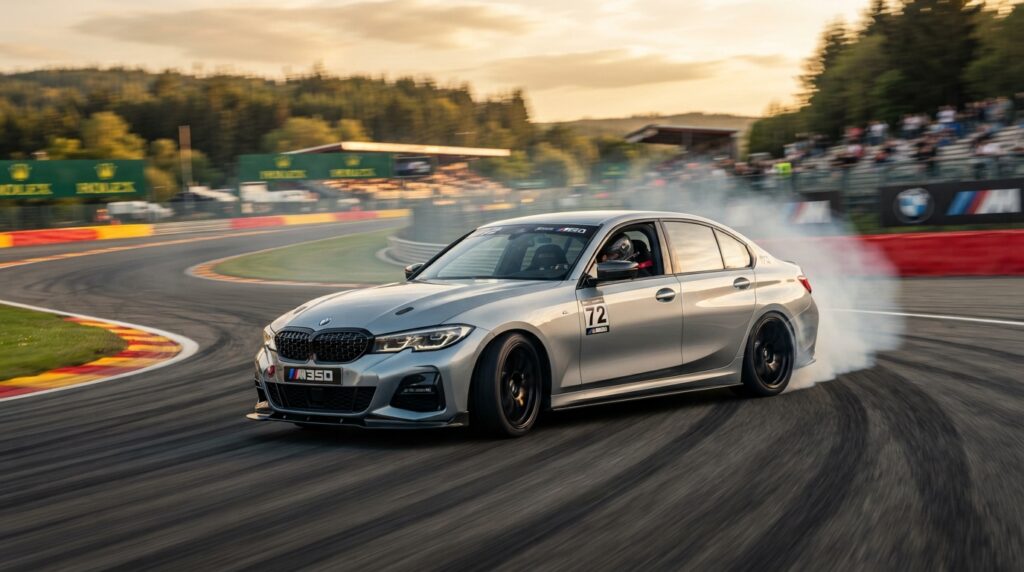
On track, the new 3 Series delivers the same tight, communicative steering that has defined this nameplate for decades, with the added torque of the M350’s updated six-cylinder engine giving it noticeably stronger corner-exit acceleration than the outgoing M340i. The chassis feels tighter overall, benefiting from stiffer underpinnings that come as part of the CLAR II platform update, and body roll through fast transitions is well controlled without feeling artificially stiff on rougher pavement.
The base 330i is expected to carry over a familiar 2.0-liter turbocharged four-cylinder producing around 260 horsepower, a modest bump over the outgoing engine’s 255 hp, paired exclusively with an eight-speed automatic transmission. Both rear-wheel-drive and all-wheel-drive configurations remain available across the lineup, giving buyers flexibility depending on climate and driving priorities.
What Powertrains Will Be Available?
The 2027 BMW 3 Series lineup carries over familiar four-cylinder and inline-six engine options rather than introducing something entirely new, keeping the formula that has worked well for the outgoing generation. Here’s how the expected lineup breaks down:
| Trim | Engine | Approx. Horsepower | Transmission |
|---|---|---|---|
| 330i | 2.0L Turbo I4 | ~260 hp | 8-speed automatic |
| M350 (replaces M340i) | Mild-hybrid B58 Turbo I6 | 400+ hp | 8-speed automatic |
| i3 (separate EV model) | Dual electric motors | TBD | Single-speed |
BMW has confirmed that mild hybrid technology carries over from the outgoing G20 generation, giving a modest boost to efficiency and low-speed response without turning the 3 Series into a plug-in hybrid. A separate plug-in hybrid variant may return later in the model cycle, though BMW has not confirmed final details for the US market.
How Does the Interior and Technology Compare?
Inside, the 2027 3 Series adopts styling cues borrowed from BMW’s Neue Klasse-era models, including the recently launched iX3, with a cleaner dashboard layout and updated digital displays that move away from the increasingly cluttered infotainment systems of recent BMW generations. The outgoing 3 Series had been criticized for feeling somewhat spartan for the price compared to rivals, and BMW appears to be addressing that directly with a more generous standard features list on the redesigned car.
Expect the same core technology found in the iX3 to filter down, including updated driver-assist software and a cleaner center touchscreen layout. BMW design chief Adrian van Hooydonk has said the goal is for the combustion and electric versions to look similar enough that buyers can barely tell them apart from the outside, even though they’re built on completely different platforms underneath.
How Does the New 3 Series Compare to Its Rivals?
The 2027 BMW 3 Series will continue to compete against the Mercedes-Benz C-Class and Audi A4 in the traditional gas-powered luxury sedan space, while also facing new pressure from the Tesla Model 3 and upcoming electric sedans as buyers weigh gas versus electric options side by side. That competitive landscape is part of why BMW chose to split the 3 Series into two dedicated platforms rather than trying to force one architecture to do both jobs well.
A few things stand out about this approach compared to rivals:
- Dedicated combustion platform means the gas 3 Series doesn’t have to compromise packaging or weight distribution to accommodate a battery pack, something several competitors still deal with in their dual-platform vehicles.
- Shared design language with the i3 keeps brand identity consistent, even though the cars are mechanically unrelated.
- No manual transmission puts the 3 Series in line with nearly every other car in the segment, since manual take rates have fallen sharply industry-wide.
Is the 2027 3 Series Worth Waiting For?
For buyers who prioritize driving feel above all else, the 2027 BMW 3 Series looks like a genuine step forward, with a stiffer chassis, a more powerful M350 variant, and styling that finally moves past the oversized grille design that drew criticism on recent BMW models. Current 3 Series pricing ranges from roughly $48,675 for the base 330i to nearly $65,000 for the all-wheel-drive M340i, and while BMW hasn’t confirmed final 2027 pricing, a modest increase over these figures would be a reasonable expectation given the scope of this redesign.
Buyers who are specifically interested in going electric should note that this generation’s EV variant, the i3, is a genuinely separate model with its own name, platform, and driving character, so cross-shopping the two isn’t as simple as picking a trim level. For traditional sedan buyers who don’t need three rows of seating or SUV-level cargo space, and who are weighing this against something like a redesigned Nissan Altima or a Chevrolet Equinox EV, the 2027 3 Series remains firmly focused on the driving experience that has defined this nameplate since the 1970s.
Frequently Asked Questions
Is the 2027 BMW 3 Series available with a manual transmission?
No, the 2027 3 Series is the first generation since the E21 debuted decades ago to drop the manual transmission entirely, with every trim now paired exclusively to an eight-speed automatic.
What replaces the BMW M340i for 2027?
The M340i is being replaced by a new M350 trim, which uses a revised mild-hybrid version of BMW’s B58 turbocharged inline-six engine producing at least 400 horsepower, about 30 more than the outgoing M340i.
Is the BMW i3 the same car as the 2027 3 Series?
No, the i3 is a separate, fully electric model built on BMW’s dedicated Neue Klasse platform, while the 2027 3 Series refers specifically to the gas-powered version built on the CLAR II architecture.